



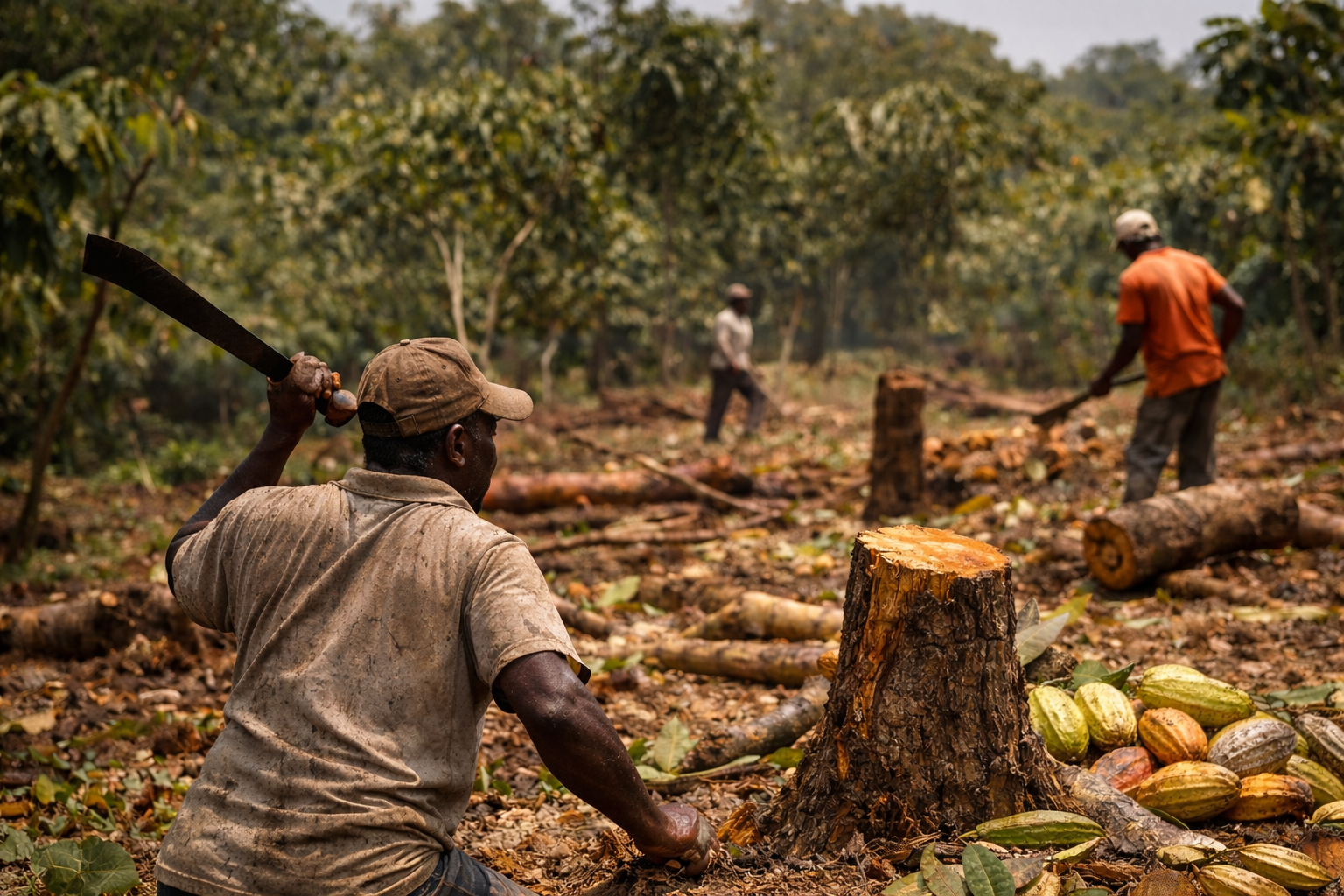
In parts of Cameroon’s cocoa-growing regions, scenes of farmers cutting down their cocoa trees have sparked concern across the agricultural sector. For many farmers, the decision to destroy their cocoa plantations is not taken lightly. It reflects deep frustration with the economic realities of cocoa farming.
For generations, cocoa has been one of the most important cash crops for rural households in Cameroon. Thousands of smallholder farmers depend on the crop to pay school fees, cover medical expenses, and support their families.
But today, many farmers say the prices they receive for cocoa beans are simply too low to sustain their livelihoods.
Cocoa farming requires significant effort and investment. Farmers must maintain their fields throughout the year, manage pests and diseases, and hire labour during peak harvesting seasons.
Yet despite this effort, many farmers say the price offered to them does not reflect the cost of production.
When the price of cocoa falls or fails to keep up with rising expenses, farmers are left with difficult choices. For some families, the income from cocoa is no longer enough to meet basic needs.
As a result, many households are experiencing increasing financial pressure.

The economic challenges faced by cocoa farmers extend beyond the farm. When farmers earn less income, entire households are affected.
In many rural communities, cocoa income is used to pay for children’s education. Lower earnings mean some parents struggle to cover school fees, uniforms, and learning materials.
In some cases, children may be forced to miss school or drop out entirely.
Healthcare is another area affected. When farm income declines, families may delay seeking medical treatment because they cannot afford the cost.
Food security can also become a concern. Some farmers report that during poor seasons they must rely more heavily on subsistence crops or reduce household spending.
Most cocoa in Cameroon is produced by smallholder farmers who operate on relatively small plots of land. These farmers typically have limited access to finance, modern farming technologies, or crop insurance.
When market prices fall, smallholders have very little protection from the economic shock.
Unlike large agribusinesses, small-scale farmers often have no savings or financial buffer to absorb losses.
This makes them particularly vulnerable when the cocoa market becomes unstable.
Another challenge with cocoa farming is the long production cycle. Cocoa trees take several years before they begin producing pods, which means farmers must wait a long time before seeing returns on new plantations.
When prices remain low for extended periods, farmers begin to question whether continuing with cocoa farming is worth the effort.
For some, cutting down old cocoa trees becomes a desperate attempt to start over or shift to crops that may provide quicker income.
The frustration among cocoa farmers should serve as a warning for the wider agricultural sector. If farmers cannot earn a sustainable income from cocoa, the long-term future of the crop could be at risk.
Younger generations in farming communities may also become discouraged from continuing in agriculture if they see their parents struggling despite years of hard work.
Without meaningful improvements in farmer incomes, cocoa farming could gradually decline in some areas.
Ensuring that cocoa farmers receive fair and sustainable incomes is essential for the stability of the entire cocoa value chain.
Governments, industry players, and development partners all have a role to play in supporting farmers through fair pricing systems, improved productivity programs, and stronger farmer organizations.
Investing in rural infrastructure, farmer training, and access to markets can also help improve the resilience of cocoa farming communities.
Ultimately, the sustainability of the cocoa sector depends on the wellbeing of the farmers who grow the crop.
If their livelihoods continue to be threatened by low prices, the consequences will extend far beyond the farm — affecting families, communities, and the future of cocoa production itself.

Woodgate House
Suit 208-209
Cairo Road Lusaka Zambia,
Email: agricoopnews@yahoo.com
Cell: 0955 791 676


.png)